Talc loading in polypropylene is a trade-off, not a dial: stiffness and heat resistance rise while impact and elongation fall. This guide explains what each increment changes, how mesh grade interacts with the ratio, and a one-week trial protocol for fixing a specification.
Talc is not a filler you can add "as much as possible". In polypropylene, the loading ratio decides stiffness, impact behaviour, shrinkage and surface finish at the same time — and those effects move in opposite directions. This guide explains what each increment of talc actually changes in a PP compound, how the mesh grade interacts with the ratio, and a one-week trial protocol you can run before you fix a specification.
Why the loading ratio, not the grade alone, decides PP performance
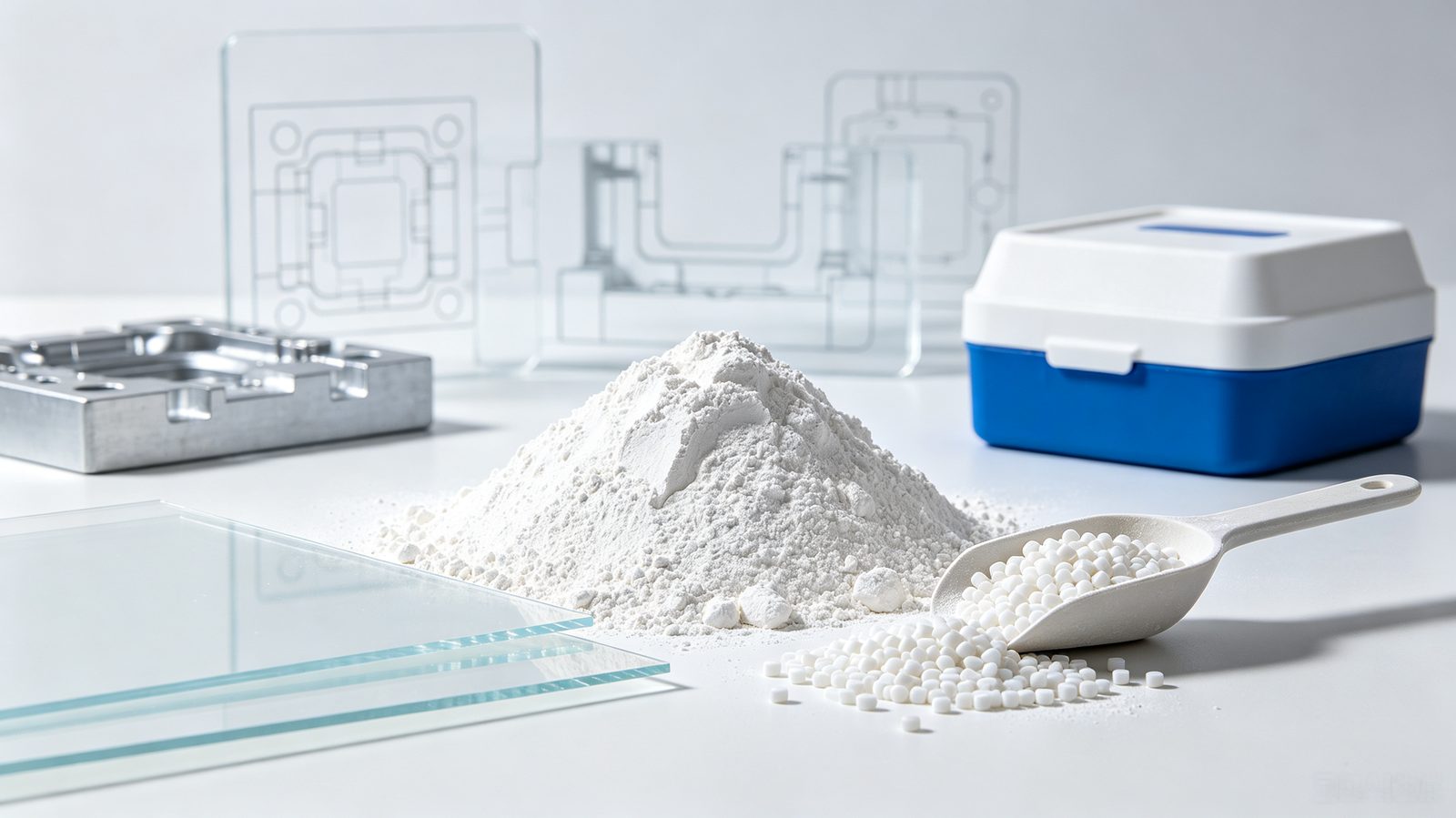
Talc is a lamellar (plate-like) mineral. Once its platelets are dispersed in a PP matrix they restrict the movement of the polymer chains: the compound becomes stiffer and more dimensionally stable, but it also gives up some of the elongation and impact energy absorption that made the base resin tough. Both effects scale with how much talc is present, so the loading ratio is the main lever; the grade (mesh, D50, surface treatment) mainly decides how efficiently that lever works.
The practical consequence: two suppliers can both quote "20% talc PP" and still deliver different parts, because the loading is only half of the recipe. Platelet size distribution, dispersion quality and coupling decide the other half — the mineral background is covered in our guide to what talc powder is.
What changes as you raise the talc loading
Stiffness, heat distortion and creep
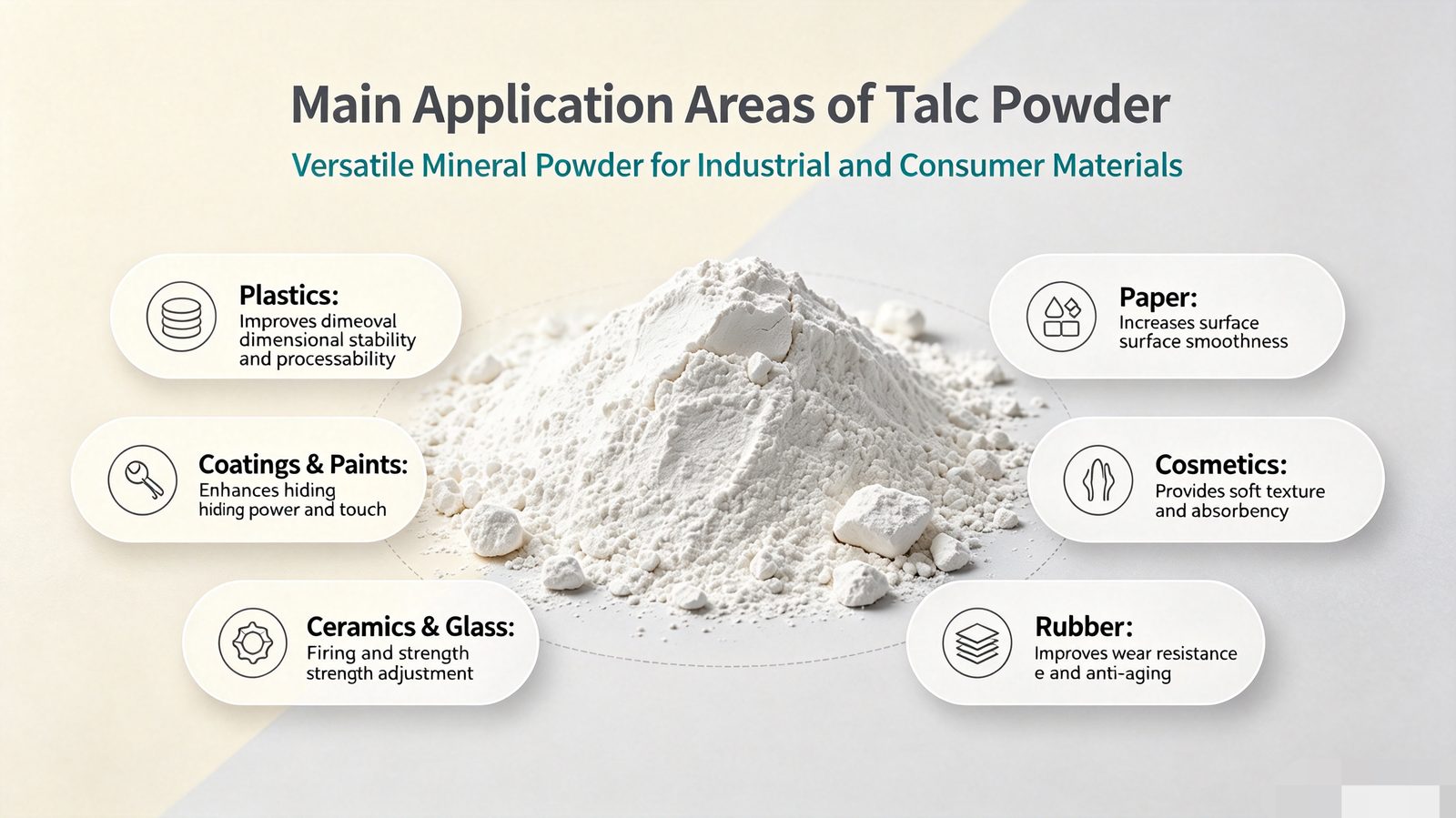
Flexural modulus and heat deflection temperature rise with loading, and creep under sustained load falls. That is why mineral-filled PP is chosen for parts that must hold their shape when warm or loaded — appliance housings, automotive interior brackets, household articles and profiles.
Impact strength and elongation at break
Notched impact and elongation at break fall as loading rises, and the loss is worst at low temperature. The fall is not linear: the first increments of talc usually cost proportionally more impact than the later ones. If the part is impact-critical, the loading is an engineering budget rather than a purchasing decision.
Shrinkage, warpage and surface finish
Because plate-like particles orient during flow, shrinkage becomes anisotropic: flow direction and cross direction shrink differently. In flat parts that usually reduces warpage compared with neat PP, but it can leave a visible flow pattern. Higher loadings generally give a matte, more mineral surface; gloss and weld-line appearance still have to be validated on the real tool.
How the mesh grade interacts with the loading
Finer grades (higher mesh, lower D50) disperse better, deliver more stiffness per unit of loading and give a smoother surface — but they need more compounding energy, generate more dust and cost more per tonne. Coarser grades from 325 to 800 mesh feed and wet out more easily and are often the economical choice at high loadings, where stiffness is already sufficient.
Our range runs from 325 mesh through 1250 mesh to ultra fine 2000 mesh. The mesh size guide explains how mesh maps to D50 and D97, which is the number your compounder will actually work with, and this article covers mesh-to-micron conversion.
Coupling and dispersion: the other half of the answer
Untreated talc is hydrophilic and polypropylene is non-polar. Without a coupling route — typically maleic-anhydride-grafted PP, or a silane treatment applied to the filler — the interface stays weak and raising the loading buys stiffness at a disproportionate cost in impact. Two practical points come up in almost every trial:
- Moisture matters. Talc is hygroscopic. A damp filler produces volatiles, voids and unstable feeder readings; dry or pre-dry to your compounder's specification and keep the bags sealed until use.
- Feeding consistency beats a bigger ratio on paper. A starved feeder delivers a lower effective loading and unstable dimensions. Weight-loss feeders with a refill check hold the ratio you actually specified.
A one-week trial protocol before you fix a specification
Instead of arguing over one number, run a small ladder and let the part decide:
- Day 1–2: pick a trial loading, compound it with the grade you intend to buy, and record the real feeder percentages and torque.
- Day 3–4: mould the part and measure thickness, warpage and sink marks instead of judging by feel.
- Day 5–6: run the mechanical tests your customer's specification requires — tensile, flexural and notched impact at the temperatures written in that specification.
- Day 7: repeat once at a lower and once at a higher loading. Keep the two data points that bracket acceptable part performance: that range, not a single figure, is the specification worth writing.
What to send us so we quote the right grade
Tell us the polymer and process (injection, extrusion or masterbatch carrier), the mesh or D50 you are working to, the properties you cannot lose, and the loading band you want to explore. We will quote from the talc powder range ground at our own plant in Haicheng, Liaoning, and send a free sample with its COA and the sieve analysis of that exact batch. If the part sits in the plastics segment, say so and we will attach the specification sheet matching that use.