Talc quotations look alike on paper but delivered lots can differ widely. This guide shows how to evaluate a talc powder supplier in China: source region, batch-to-batch consistency, COA and asbestos testing, capacity and plant discipline, packaging and export logistics.
Talc is one of those raw materials where every quotation looks alike on paper — a white powder, a mesh number, a whiteness figure — yet delivered lots can behave very differently on the same production line. Most of that variation is decided long before the bag is filled: in the ore body, the grinding and classification circuit, and the discipline of the quality system behind them. This guide sets out how an international buyer can evaluate a talc powder supplier in China before committing to a first container, and which questions separate a producer that controls its process from a trader with a price list.
Start with the source region
China mines talc in several provinces, but the belt around Haicheng in Liaoning has become the reference for plastics and coatings grades: the local ore tends toward lamellar talc with steady chemistry, and decades of export processing have built a dense cluster of grinding, classification and quality infrastructure around it. If stiffness, heat deflection or low abrasion on your screws and rolls is the reason you buy talc, a lamellar ore source is where a serious specification starts.
What the region tells you — and what it does not
Regional origin is a shortlisting filter, not a certificate. Two plants in the same county can differ completely in how they quarry, blend and test. Ask each supplier directly: do you process ore from your own or long-term contracted sources, and which feeding areas supplied my lot? A producer that can name its feed source and show lot-level records is a very different risk from one that buys lump talc on the open market whenever the price is right.
Judge consistency, not the catalogue specification
Any producer can hit a target once. The commercially important question is what arrives in month six of the contract. For an introduction to the material itself, see our guide to what talc powder is; for supplier evaluation, pin these four parameters down in writing:
- Fineness. State the mesh together with a D50 or top-cut tolerance. Our talc is ground and classified from 325 to 3000 mesh, and adjacent mesh grades can behave differently in the same formulation — the mesh size guide explains the mapping.
- Whiteness. Agree a range you will accept, not a single best-case value, and require each lot's measured figure on the certificate.
- Chemistry. Talc is a magnesium silicate; SiO2 content varies with the ore and with accessory minerals such as chlorite and carbonate. Typical industrial talc runs roughly 20–65% SiO2 depending on grade, so define the window your process tolerates.
- Moisture. Caking and dosing problems after long distance shipping are usually moisture problems. Set a limit and check it on arrival.
The testing questions worth asking directly
Which standard is each figure measured to — sieve, laser diffraction, or both? How often is production sampled, and are retain samples kept so a dispute can be re-tested against the same reference? Suppliers with an in-process quality system answer these without hesitation; vague answers here predict vague batches later.
Documentation and compliance, talc-specific
Talc carries one compliance question most other mineral fillers do not: asbestos. Because talc deposits can occur alongside asbestiform minerals, a responsible supplier treats the asbestos-free claim as a tested result with a named method, not a slogan. Ask which method is used and at what sensitivity, and for demanding applications consider an independent laboratory report — the full checklist is in our article on asbestos-free talc certification. Beyond that, require a lot-specific COA with every shipment, a current TDS, and third-party inspection such as SGS at your option before loading.
Capacity, plant discipline and lead time
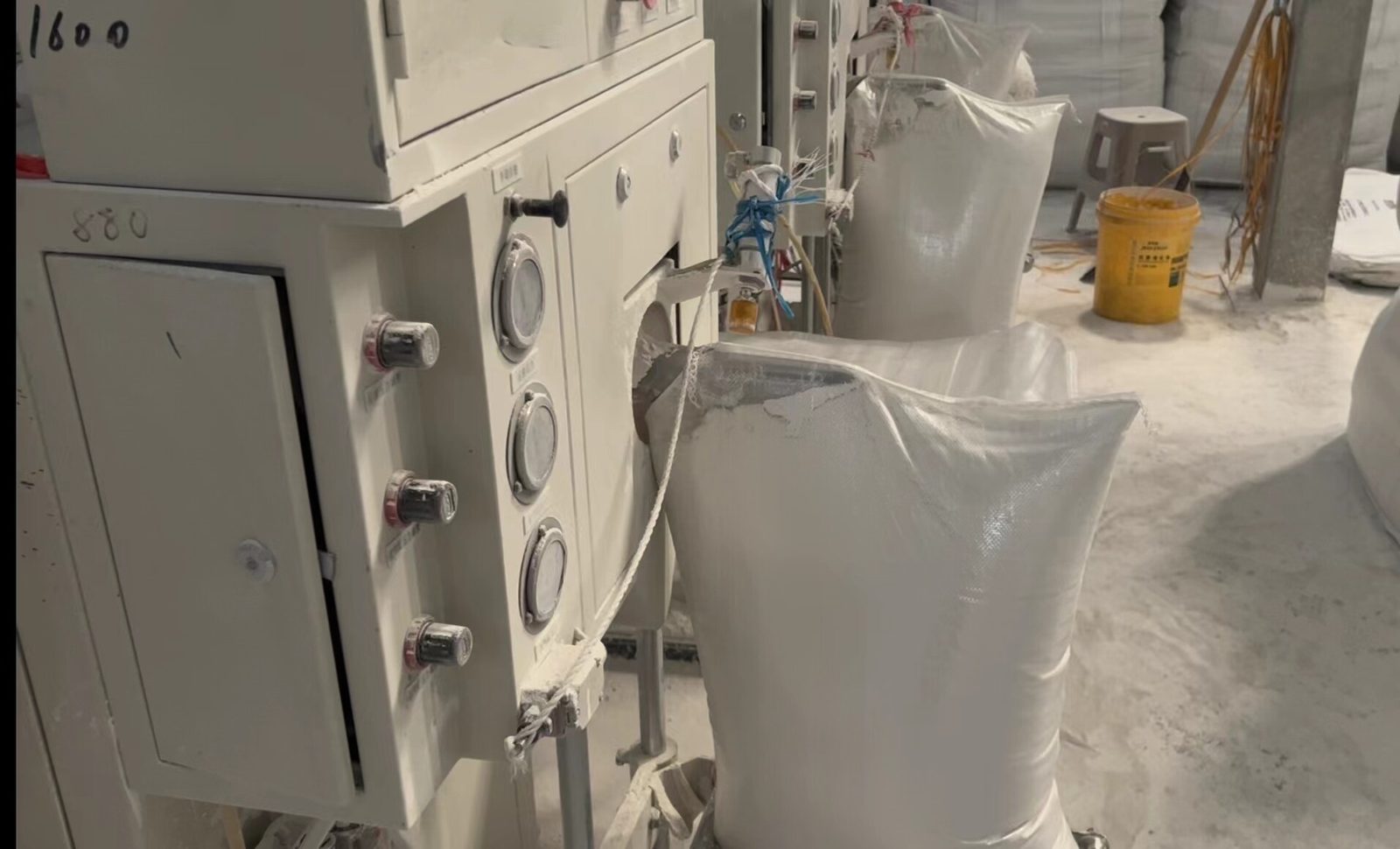
Capacity is less about the annual figure and more about what sits behind your order: how many grinding and classification lines, whether packing weights are checked hourly, whether in-process sampling catches drift before it leaves the gate. Those questions are walked through in detail in our article on how to verify a Chinese mineral powder supplier. On planning: for standard grades, a lead time of 7–15 days after the specification and packaging artwork are confirmed is a realistic figure from established Liaoning suppliers; custom specifications take longer and deserve a written schedule.
Packaging, ports and commercial terms
- Bags: 25 kg and 50 kg woven, paper-plastic composite or kraft bags; 1000 kg and 1250 kg jumbo bags for container loads; OEM printing available.
- Ports: Dalian and Yingkou in Liaoning cover most destinations; buyers may nominate other Chinese ports.
- Order size: the MOQ is normally one 20-ft container, roughly 25–27 tonnes depending on grade and packaging — our talc powder MOQ guide explains how that works for trial and repeat orders.
- Payment: T/T and L/C at sight are the norm; confirm the exact terms on the proforma invoice.
A practical vetting checklist
- Confirm the supplier processes its own or contracted ore, and can name the feed source.
- Require a current TDS and a lot-specific COA, not typical values.
- State fineness as mesh plus D50 tolerance, and whiteness as an accepted range.
- Ask which method the asbestos-free claim is tested to, and at what sensitivity.
- Request a sample from a current production lot, with its lot number.
- Agree retain samples and re-test rights in writing before the first order.
- Fix packaging, port, Incoterm and payment terms on the proforma invoice.
If you are comparing suppliers now, send us your target mesh, whiteness and application — our talc powder range covers 325–3000 mesh, and we answer with a grade recommendation, a TDS and a sample rather than a generic quotation.